جدول المحتويات
مقدمة
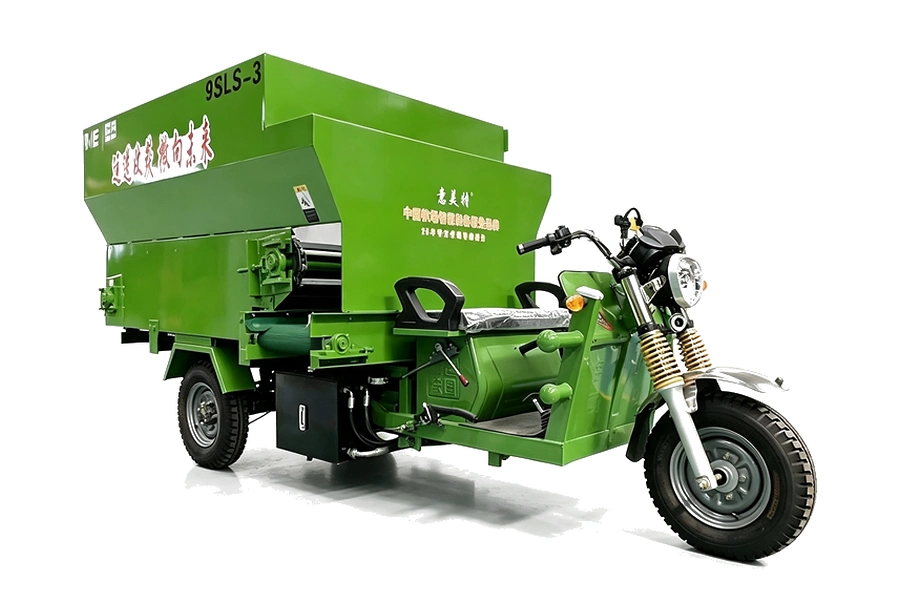
Feed distribution is one of the most important stages in modern livestock management. Even when a farm has a well-formulated ration and reliable feed preparation equipment, the final feeding result still depends on whether the feed can be delivered consistently to the animals. A feed spreader is designed to support this process by transporting and distributing prepared feed materials along livestock feeding areas with greater control and efficiency.
Unlike a feed mixer, which focuses on combining forage, silage, concentrates, and supplements into a complete ration, a feed spreader mainly handles the delivery stage after feed preparation has been completed. It helps move feed from the loading area to the feeding line and creates a more organized feeding process, especially for farms managing large quantities of feed every day.
As livestock farms continue to improve automation and reduce repetitive labor, feed distribution equipment has become increasingly important. Different farms may require different solutions depending on herd size, feeding distance, barn layout, feed type, and existing machinery. Understanding the working principles, applications, and selection factors of a feed spreader can help farms choose equipment that matches their actual feeding workflow.
What Is a Feed Spreader?
A feed spreader is agricultural equipment used to transport and distribute prepared feed materials along livestock feeding areas. Its main purpose is to place feed in a controlled and consistent position so animals can access it more efficiently.
In a typical feeding system, a feed spreader operates after the feed preparation stage. For example, a TMR feed mixer may first combine different ingredients into a balanced ration, and the feed spreader then transfers and distributes that ration along the feeding area.
The machine usually consists of a feed container, transportation mechanism, and discharge system. Depending on the design, materials may be moved through augers, conveyors, rotating drums, or other mechanical components before being released.
Different farms have different requirements, so feed spreaders are available in multiple configurations. The Feed Distribution Equipment category includes solutions designed for different livestock feeding environments, from simple feed transportation to more integrated distribution systems.
Why Is Efficient Feed Distribution Important?
Efficient feed distribution directly affects daily livestock management. A farm may invest significant resources into forage selection, ration formulation, and mixing accuracy, but inconsistent delivery can reduce the overall effectiveness of the feeding process.
When feed is placed unevenly, some animals may have easier access than others. This can increase competition around the feeding area and create differences in how animals consume the ration. For larger herds, even small variations in feed placement can become more noticeable across long feeding lines.
A controlled distribution process helps farms maintain a more consistent feeding environment. Instead of relying on manual movement or repeated adjustments, a feed spreader provides a mechanical method for delivering feed according to a planned routine.
Feed distribution also influences labor efficiency. On smaller farms, manual handling may still be practical, but as feeding distances increase, repeated movement of heavy feed materials becomes more time-consuming. Mechanized distribution helps reduce physical workload and allows employees to focus on other livestock management tasks.
How Does a Feed Spreader Work?
The working process of a feed spreader generally includes loading, transportation, and discharge. Although different models use different mechanisms, the basic purpose remains the same: moving prepared feed from one location and placing it where animals need it.
After feed is loaded into the machine, internal components move the material toward the discharge area. Some systems use rotating augers to push feed forward, while others rely on conveyor belts or similar mechanisms to control movement.
During discharge, the machine releases feed along the feeding line. The final distribution quality depends on several factors, including feed consistency, moisture content, particle size, machine speed, and operator settings.
For example, a wetter ration may move differently from dry forage, while longer fiber materials may require different handling compared with finely processed feed. A suitable feed spreader should therefore match the physical characteristics of the material being distributed.
Feed Spreader vs Feed Mixer: Understanding the Difference
Although feed spreaders and feed mixers are often used together, they perform completely different functions within a livestock feeding system.
A feed mixer prepares the ration by combining multiple ingredients into a uniform mixture. It focuses on feed formulation and ingredient integration. A feed spreader, on the other hand, focuses on transporting and distributing the prepared ration.
The difference can be summarized as follows:
| Equipment | Main Function | Position in Feeding Process |
|---|---|---|
| Feed mixer | Combines forage, silage, concentrates, and supplements | Feed preparation |
| Feed spreader | Moves and distributes prepared feed | Feed delivery |
| Feed pusher | Moves displaced feed closer to animals | Feed accessibility management |
Understanding this difference is important because farms need to identify their actual operational challenge before selecting equipment. If the problem is inconsistent ration preparation, a mixer may be required. If the problem is feed transportation and placement, a spreader may provide the appropriate solution.
Main Types of Feed Spreaders
Feed spreaders can be classified according to their structure, operating method, and level of automation. The most suitable type depends on the farm environment and feeding requirements.
| Type | Features | Suitable Application |
|---|---|---|
| Electric feed spreader | Uses electric power and compact operation | Farms requiring flexible daily feeding |
| Auger feed spreader | Uses rotating augers to move feed | Controlled feed movement along feeding lines |
| Conveyor feed spreader | Uses conveyor systems for transportation | Longer feeding routes and structured facilities |
| Tractor-mounted feed spreader | Works with existing farm machinery | Farms with available tractors |
| Automated feed spreader | Uses programmed operation | Farms seeking reduced manual labor |
Electric feed spreaders are often suitable for farms that need dedicated equipment for regular feeding tasks without depending entirely on large tractors.
Auger-based systems are commonly used where controlled movement of mixed feed materials is required. The rotating mechanism helps guide feed through the machine and supports consistent discharge.
Conveyor-based designs can be useful in structured feeding systems where feed needs to travel longer distances or follow a fixed distribution path.
Automated feed spreaders represent a higher level of mechanization by reducing the need for repeated manual operation. However, automation requires suitable barn conditions, reliable routes, and proper maintenance planning.
What Feed Materials Can a Feed Spreader Handle?
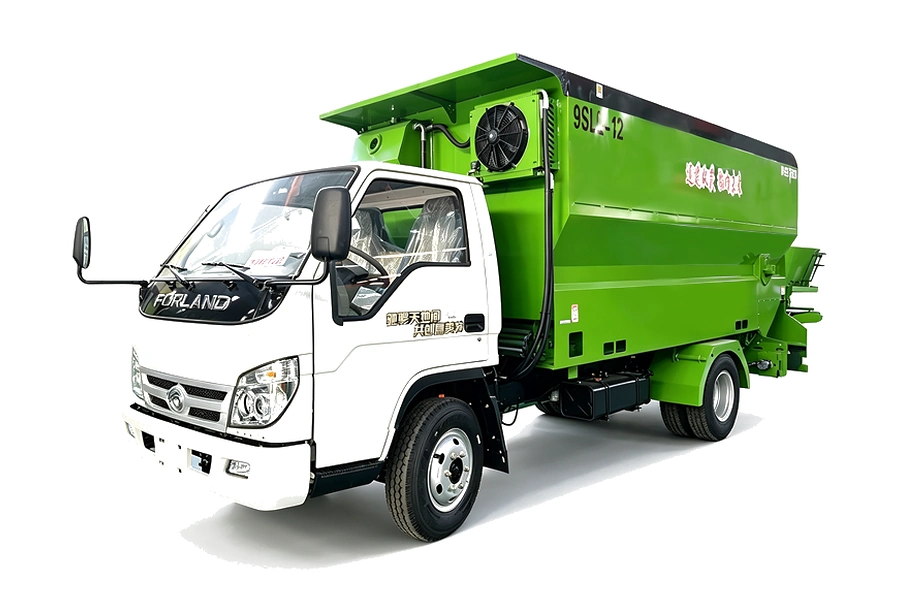
The type of material a feed spreader can handle depends largely on its design. Many machines are developed for prepared livestock rations, including mixed feed containing forage, silage, grains, and supplements.
Feed characteristics influence equipment performance. Materials with higher moisture content may move differently from dry forage, while long-fiber materials may require stronger mechanical movement compared with finely processed feed.
Particle size is another important factor. A ration containing different ingredient sizes needs a distribution system capable of moving the entire mixture without causing excessive separation.
Because feed properties vary significantly between farms, equipment selection should begin with understanding the actual materials being distributed. The right machine is not necessarily the largest one, but the one that matches the farm’s feed structure and operating conditions.
Feed Spreaders for Dairy Farms
Dairy farms are one of the most common applications for feed distribution equipment because daily feeding requires consistency and reliability.
Large dairy operations often prepare substantial quantities of ration that must be delivered across multiple feeding areas. In these situations, manual transportation becomes increasingly difficult, especially when feeding routes are long or multiple groups require different management.
A suitable feed spreader helps dairy farms organize the movement of prepared feed and reduce repeated manual handling. It can also improve consistency by placing feed closer to the intended feeding area.
However, the equipment must match the dairy facility. Barn width, feeding lane design, ration type, existing mixer capacity, and daily feeding schedules all influence whether a specific spreader configuration is appropriate.
Feed Spreaders for Cattle Farms
Cattle farms may have different feeding systems depending on herd size, housing conditions, and production methods. Some operations use centralized feeding systems, while others require flexible equipment that can move between multiple feeding locations.
Feed spreaders support these operations by improving the transportation and placement of prepared feed. For larger farms, this can reduce the amount of time spent manually moving feed and help create a more predictable feeding routine.
The selection process should consider more than animal numbers. The farm should also evaluate feeding distance, available machinery, ration type, and the physical layout of the feeding area.
A machine that works effectively in one cattle operation may not provide the same results in another because feeding environments vary significantly.
How to Choose the Right Feed Spreader?
Choosing the right feed spreader requires evaluating the entire feeding process rather than focusing on a single specification.
The first factor is feed volume. Farms should understand how much feed needs to be moved each day and how many feeding cycles are required. A machine that is too small may require excessive trips, while an oversized machine may not operate efficiently in smaller systems.
The second factor is feed characteristics. Moisture content, particle size, fiber length, and ration density all influence how easily material moves through the equipment.
Farm layout is another important consideration. Feeding lane length, turning space, storage location, and transportation distance affect how practical a machine will be during daily operation.
Available power sources should also be considered. Some farms already have tractors and other equipment available, while others may prefer dedicated electric or automated systems.
How Farm Layout Affects Feed Spreader Performance
The physical environment of the farm has a direct influence on equipment efficiency. A feed spreader must be able to move through the feeding area safely while maintaining consistent feed placement.
Important layout factors include feeding lane width, turning space, barn entrances, storage locations, and the distance between preparation and feeding areas.
A machine that is too large for the available space may create unnecessary operating difficulties. On the other hand, a machine that is too small may require additional cycles and increase daily workload.
Before selecting equipment, farms should analyze the actual route the feed spreader will follow. Understanding the complete movement path helps ensure that the chosen machine fits naturally into the existing workflow.
Automation Trends in Feed Distribution
Automation is becoming increasingly important in livestock farming because many daily tasks require repeated and consistent execution.
Automated feed distribution systems can help farms reduce dependence on manual labor and maintain more predictable feeding schedules. This is particularly valuable for larger operations where employees manage multiple responsibilities throughout the day.
However, automation should be introduced based on practical needs. The barn must provide suitable operating conditions, and the farm must have appropriate maintenance capability.
Automation is most effective when integrated with other feeding processes, including ration preparation, feed pushing, and livestock monitoring.
Common Feed Spreader Selection Mistakes
One common mistake is choosing equipment based only on capacity. A larger machine does not always provide better performance if it does not match the farm’s actual feeding volume and layout.
Another mistake is ignoring feed characteristics. Equipment designed for one material type may not perform effectively with another, especially when moisture levels and particle sizes differ significantly.
Poor planning of the operating route can also create problems. If the machine cannot move efficiently between preparation and feeding areas, expected labor savings may not be achieved.
Maintenance requirements should also be considered. Components such as augers, conveyors, motors, and discharge systems require regular inspection to maintain reliable operation.
Maintenance Requirements for Feed Spreaders
Feed spreaders operate in environments where dust, moisture, and feed residue are common. Regular maintenance is therefore essential for stable performance.
Moving components such as augers, conveyors, bearings, and drive systems should be inspected periodically. Material buildup should be removed to reduce unnecessary wear.
Electric systems require attention to motors, wiring, batteries, and control components. If the equipment includes hydraulic systems, hoses and connections should also be checked regularly.
Preventive maintenance helps reduce unexpected downtime and ensures that the feed spreader continues to perform consistently during daily feeding operations.
How Feed Spreaders Fit Into a Complete Feeding System
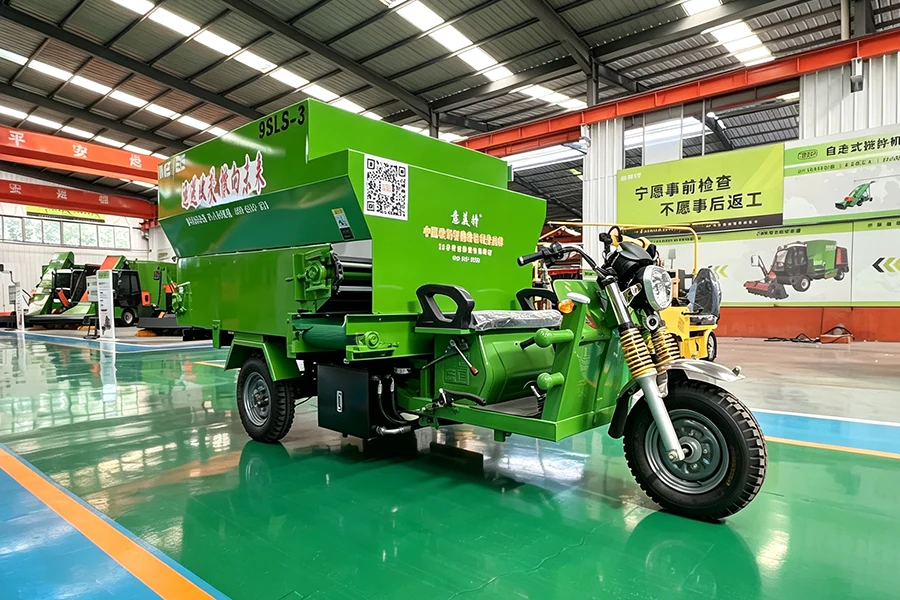
A feed spreader is only one part of a complete livestock feeding workflow. Before distribution begins, feed must be stored, measured, prepared, and mixed. After feed reaches the animals, additional management such as feed pushing may also be required.
A complete feeding system may include feed storage, TMR mixing, transportation, spreading, feed pushing, and monitoring of feed availability.
Each stage affects the next. A high-quality ration can lose efficiency if distribution is inconsistent, while precise spreading cannot compensate for poor feed preparation.
For this reason, farms should evaluate feeding equipment as an integrated system rather than selecting individual machines separately.
خاتمة
A feed spreader is an important part of modern livestock feeding systems because it improves the transportation and distribution of prepared feed. Unlike feed mixers that focus on ration preparation, feed spreaders focus on delivering feed consistently and efficiently to livestock.
The best feed spreader depends on multiple factors, including feed type, daily volume, farm layout, feeding distance, available machinery, labor requirements, and automation goals.
For farms considering new feeding equipment, the most effective approach is to analyze the complete feeding workflow and identify where distribution creates operational challenges. When equipment matches the actual needs of the farm, it can improve feeding consistency, reduce repetitive labor, and support more efficient livestock management.
الأسئلة الشائعة
What is the main purpose of a feed spreader?
A feed spreader is designed to transport and distribute prepared feed along livestock feeding areas. It helps farms improve feed placement consistency and reduce manual handling during daily feeding operations.
What is the difference between a feed spreader and a feed mixer?
A feed mixer combines ingredients to create a complete ration, while a feed spreader delivers the prepared ration to the feeding area. They perform different stages of the livestock feeding process.
Can a feed spreader handle TMR feed?
Many feed spreaders are designed to distribute prepared TMR feed. However, compatibility depends on the feed moisture, particle structure, density, and machine design.
How do I select a suitable feed spreader?
Selection should consider feed type, daily volume, feeding route, barn layout, available power equipment, automation requirements, and maintenance needs.
Are automated feed spreaders suitable for every farm?
Automated feed spreaders can improve efficiency on farms with suitable layouts and repeated feeding requirements. However, farms should evaluate route conditions, maintenance capability, and operational needs before choosing automation.
Need Help Choosing the Right Feed Spreader?
Selecting suitable feed distribution equipment requires understanding feed type, daily volume, barn layout, feeding routes, and existing farm systems. Share these requirements with the فريق معدات الثروة الحيوانية LTSZ to discuss a feed spreading solution that matches your livestock operation.