Índice
Self-Propelled Bedding Spreader: Define the Farm Requirement
Self-propelled bedding spreader should be evaluated against a defined job: loading bedding and placing a controlled layer in the intended resting area. Start with stall access, discharge reach and the material’s flow behavior and the material handled on an ordinary working day. Use the checks below to establish the operating limits and the evidence needed before choosing a configuration.
Bedding equipment must match the material and resting-area geometry. Straw, sawdust and sand differ in density, abrasiveness, bridging behavior and airborne dust. Compatibility with one material does not prove suitability for another. The intended outcome is repeatable placement where animals rest, with a practical replenishment routine. Ventilation, moisture management, bedding storage and cleaning remain part of the housing system; a spreader alone cannot guarantee animal-health outcomes.
Self-Propelled Bedding Spreader: Keep records that answer a maintenance or feeding question
A practical self-propelled bedding spreader record identifies date, operator, machine, task, material condition and settings. Add material used per bed, distribution coverage and replenishment time using a consistent measurement method. Keep the form short enough to complete at the work site. Do not collect detailed data without deciding which operating, service or procurement question it will help answer.
For self-propelled bedding spreader, preserve target and actual results separately. Record interventions, incomplete tasks and changed settings instead of overwriting them with the final successful result. Link photographs or fault codes to the same event identifier. This makes it possible to investigate an apparently fast pass that leaves uneven depth, wet clumps or excessive dust and prevents a later review from assuming the entire round ran normally.
Review records with operators at a useful interval and assign action to recurring exceptions. Keep original observations intact when adding a diagnosis or correction. Use the data to refine stall access, discharge reach and the material’s flow behavior and the service plan. A simple, consistent log is more valuable than an elaborate spreadsheet with missing definitions and unverified zero entries.
Self-Propelled Bedding Spreader: Stock parts against actual failure consequences
A self-propelled bedding spreader spare-parts plan should identify scraper chains, belts, augers, outlet seals and exposed bearings by the correct part number and configuration. Ask which parts normally wear, which prevent essential work when unavailable and which can be obtained quickly. Record supplier lead time and local service options. A large undifferentiated parts kit can tie up money without covering the item most likely to stop the task.
For self-propelled bedding spreader, separate operator-replaceable consumables from repairs requiring trained service personnel. Confirm required tools, isolation procedures and any recalibration after replacement. Check shelf life and storage conditions for seals, batteries, lubricants and other sensitive items where relevant. Keep parts clean, labeled and linked to the correct machine serial number.
Use downtime records to revise the stock list. Compare the cost of a spare with the likely delay, fallback capacity and delivery time. Replenish a used critical item promptly and record the repair outcome. Do not substitute an apparently similar safety-critical or load-bearing component without the manufacturer’s approval. Parts availability is a service requirement that should be discussed before ordering.
Self-Propelled Bedding Spreader: Build the cost model from measured work
Compare self-propelled bedding spreader options using annual ownership and operating cost alongside the work they actually complete. List purchase price, freight, site preparation, training, finance where relevant, energy, wear parts, routine service and the fallback method during downtime. Use the same operating hours and workload for every option. Keep assumptions such as annual utilization visible so they can be changed without rebuilding the comparison.
For self-propelled bedding spreader, staff time includes supervision, loading, cleaning and dealing with interrupted work. Separate time released from time that becomes a cash saving. If a person still works the same paid shift, the benefit may be additional capacity or a more reliable routine. Measure material used per bed, distribution coverage and replenishment time before and after the trial. Avoid assigning a fixed milk-yield, feed-saving or labor-saving percentage without evidence from the farm.
Calculate at least a low-utilization and a high-utilization case, and vary service cost and downtime independently. If annual net savings are uncertain or negative, show that result directly instead of forcing a payback figure. Check that an inexpensive option does not require unpriced changes to the bedding store, hopper outlet and occupied or cleared stall row. A useful cost model shows what would have to be true for the self-propelled bedding spreader purchase to make economic sense.
Self-Propelled Bedding Spreader: Translate the specification sheet into operating limits
Read the self-propelled bedding spreader specification sheet as a description of one configuration. Separate dimensions, installed power, permitted load, working output and optional functions. Identify whether each number is a maximum, a nominal value or a result under stated test conditions. Relate the sheet to stall access, discharge reach and the material’s flow behavior. Missing conditions deserve a written clarification before two quotations are compared.
For self-propelled bedding spreader, confirm the material used to establish any capacity or output claim. Record the exact model, attachments, drive system and discharge arrangement. A label such as automatic, heavy duty or intelligent is not a complete operating requirement. Ask which actions are automatic, which require an operator and what happens when the normal sequence stops. Verify the interface through the bedding store, hopper outlet and occupied or cleared stall row with drawings where possible.
Crie uma linha de comparação para cada requisito e anexe as evidências do fornecedor Marque as entradas não suportadas como não confirmadas Não leve uma especificação de um modelo relacionado para o registro do modelo selecionado Quando uma opção muda de peso, dimensões ou demanda de energia, atualize a rota e as verificações de utilidade também A ordem final deve identificar a mesma configuração que o teste de aceitação avaliará.
Self-Propelled Bedding Spreader: Compare configurations against the same task
Compare self-propelled bedding spreader configurations using one defined work round and the same the intended straw, sawdust, husks or other approved bedding material. Begin with stall access, discharge reach and the material’s flow behavior, then assess the bedding store, hopper outlet and occupied or cleared stall row, staffing, measurement, maintenance and service access. A configuration that excels at maximum output may be inconvenient for a small routine task. State the task before deciding which option has the stronger fit.
Ask for demonstrations under comparable conditions. For each self-propelled bedding spreader option, record material used per bed, distribution coverage and replenishment time, full cycle time and interventions. Note which result comes from a measured trial and which remains a supplier statement. Separate features included in the base price from options. Do not compare a fully configured demonstration unit with a lower-priced quotation that omits the relevant feature.
Use a short decision table with evidence and unresolved questions. Avoid a numerical score that disguises a missing mandatory capability. If an option cannot pass a required access, material or safety condition, resolve that item before comparing preferences. The purchase decision should remain understandable to the operator and service team who will use self-propelled bedding spreader.
Uma pecuária mista que partilha maquinaria entre empregos
Create a task order that separates clean feed and bedding from manure work. Attachments, contact surfaces and receiving areas may require different handling and cleaning procedures. Record the changeover time as part of the full job. A shared machine can reduce duplicate investment only if the conflicting tasks fit the available hours. Allocate responsibility for checking self-propelled bedding spreader before the next use, especially when different teams work on the same day. Evaluate the most awkward interface rather than using the easiest task as the demonstration for the entire farm.
A Worked Planning Example for Self-Propelled Bedding Spreader
If an illustrative 200 stalls each receive 2 kg of replenishment, one round uses 400 kg. At a measured loose density of 100 kg/m³, that represents 4 m³ before any allowance. A heavier, wetter material changes both handling and mass even if the same hopper volume is loaded. Establish the farm’s bedding target with its management team. Check the actual placement in the stall rather than using hopper-emptying time as the sole performance measure.
Verificações de configuração e evidências de suporte
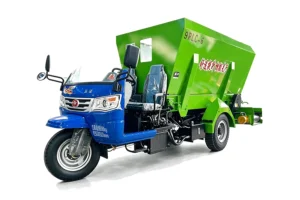
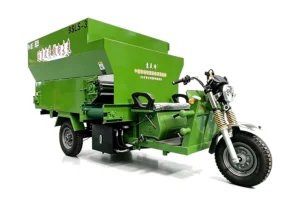
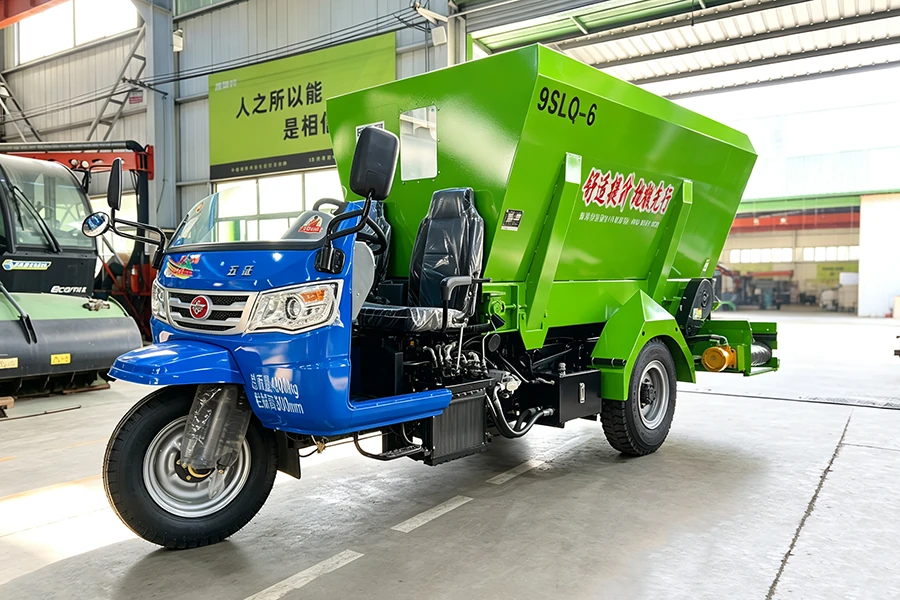
LTSZ lista o Espalhador de cama de três rodas within its livestock equipment portfolio. The product page records Model: 9SLQ-6; Vehicle Model: Wuzheng; Engine Speed: 2200 r/min. Treat these entries as a starting point for a configuration discussion and request the current model sheet before placing an order. Confirm that the proposed self-propelled bedding spreader arrangement fits the bedding store, hopper outlet and occupied or cleared stall row.
For this application, ask the team to measure bedding mass or volume used across a known number of stalls and compare placement depth at representative points. Provide a layout drawing, the intended the intended straw, sawdust, husks or other approved bedding material and the required work window. The quotation should identify included options, service access and the evidence needed for handover. You can also review the Portfólio de equipamentos LTSZ para entender os estágios adjacentes de alimentação e limpeza.
Compare as opções antes de se comprometer
| Decisão | O que comparar | Provas a solicitar |
|---|---|---|
| Ajuste de tarefa | loading bedding and placing a controlled layer in the intended resting area | Uma rodada de trabalho completa demonstrada |
| Ajuste material | the intended straw, sawdust, husks or other approved bedding material | Condições de ensaio e observações reais |
| Site fit | stall access, discharge reach and the material’s flow behavior | Desenho de configuração e levantamento de rotas |
| Desempenho | material used per bed, distribution coverage and replenishment time | Um registo de aceitação reprodutível |
| Servibilidade | scraper chains, belts, augers, outlet seals and exposed bearings | Manual, números de peça e procedimento de acesso |
- Trial the actual bedding material and moisture range.
- Measure placement at the near and far edges of the resting area.
- Check dust behavior from a safe observation position.
- Confirm the machine fits the cleared stall-access route.
Para obter informações independentes, leia University of Minnesota Extension guidance on cow comfort. This resource places resting surfaces and bedding within housing management. It does not establish that a particular bedding machine improves health or milk output.
Discuta suas necessidades agrícolas
To discuss self-propelled bedding spreader, send your farm layout, daily workload, material details and delivery destination to LTSZ. Peça uma configuração proposta com os limites operacionais, escopo de cotação e verificações de aceitação estabelecidos por escrito Inclua a principal restrição identificada neste guia para que a discussão comece com o trabalho que sua fazenda precisa concluir.
Perguntas frequentes
What information is needed to specify self-propelled bedding spreader?
To specify self-propelled bedding spreader, start with loading bedding and placing a controlled layer in the intended resting area, the daily workload and the available work window. Add drawings of the bedding store, hopper outlet and occupied or cleared stall row, material details and the result the farm needs to verify.
How should self-propelled bedding spreader performance be checked?
Evaluate self-propelled bedding spreader using material used per bed, distribution coverage and replenishment time as the operating evidence. A practical approach is to measure bedding mass or volume used across a known number of stalls and compare placement depth at representative points. Record settings and conditions so the result can be compared with routine work.
Can self-propelled bedding spreader be selected from capacity alone?
Capacity must be checked alongside stall access, discharge reach and the material’s flow behavior. Confirm material behavior, access, complete cycle time and support requirements. A nominal figure cannot establish every part of the task.
Which self-propelled bedding spreader maintenance points need attention?
Inspect scraper chains, belts, augers, outlet seals and exposed bearings according to the exact model manual. Assign responsibility, use the required isolation procedure and record recurring wear or adjustment needs.
What should a self-propelled bedding spreader quotation include?
Solicite o modelo e configuração, desenhos, especificações atuais, opções incluídas, escopo de entrega, treinamento, peças de reposição e termos de serviço Concorde com o método de aceitação antes de fazer o pedido.