Tabla de contenidos
Introducción

What is a TMR feed mixer, and why has this type of equipment become so important in modern livestock feeding? A TMR feed mixer is designed to combine forage, silage, concentrates, minerals, supplements, and other ration ingredients into a relatively uniform mixture before the feed is distributed to livestock. TMR stands for Total Mixed Ration, a feeding approach commonly used in dairy and cattle operations where different ingredients need to be prepared as one controlled ration.
The role of a TMR mixer goes beyond simply stirring feed together. On a working livestock farm, the machine connects several stages of the feeding process, including ingredient loading, weighing, forage processing, mixing, transport, and discharge. When these steps are properly coordinated, farms can prepare daily rations more consistently while reducing the amount of manual handling required for large feed volumes.
Choosing a suitable mixer therefore involves more than comparing chamber sizes. Herd size, ration composition, forage characteristics, the number of feeding groups, available loading equipment, barn layout, feeding frequency, discharge method, and future expansion all influence which configuration is suitable. Understanding how the equipment works is the first step toward selecting a machine that fits the farm rather than forcing the farm to adapt to the machine.
What Is a TMR Feed Mixer?
A TMR feed mixer is livestock feeding equipment that receives measured quantities of several feed ingredients and mechanically combines them inside a mixing chamber. Depending on the design, the machine may also cut long forage, weigh individual ingredients, transport the prepared ration, and distribute it directly along a feeding lane.
The basic operating principle is relatively simple. Ingredients such as silage, hay, straw, concentrates, grains, minerals, and supplements are loaded into the mixing chamber according to a planned ration. One or more augers, rotors, reels, or other mixing components then move the materials through the chamber so that ingredients with different particle sizes, moisture levels, and densities become distributed throughout the batch.
This process is particularly useful on farms that need to prepare large quantities of feed repeatedly. Instead of handling forage and concentrates as separate feeding operations, a TMR system allows the farm to organize them into one controlled preparation process. Different TMR feed mixer configurations can support stationary, towed, or mobile feeding workflows depending on the structure of the farm.
What Does TMR Mean in Livestock Feeding?
TMR means Total Mixed Ration. In this feeding system, the major ingredients required for a particular group of animals are incorporated into one mixture rather than being offered separately. A ration may contain silage, hay, straw, grain, protein ingredients, minerals, vitamins, and other supplements, although the exact formulation depends on the livestock type, production stage, available forage, and nutritional program.
The purpose of the TMR approach is to make the physical composition of the feed more consistent throughout the ration. When forage and concentrates are provided separately, livestock may be able to select certain components more easily. Mixing the ingredients together helps reduce this separation and supports a more controlled feeding process.
TMR should not be confused with ration formulation itself. The mixer does not determine how much protein, fiber, energy, mineral, or other nutrient an animal requires. Those decisions belong to nutritional management. The machine is responsible for processing and combining the ingredients according to the selected formula so that the prepared batch can be distributed efficiently.
Guidance on Total Mixed Rations for dairy cows also emphasizes that successful TMR feeding depends on more than the mixer alone. Forage quality, dry matter, grouping, feed management, ingredient consistency, and operating procedures all influence the final feeding result.
How Does a TMR Feed Mixer Work?
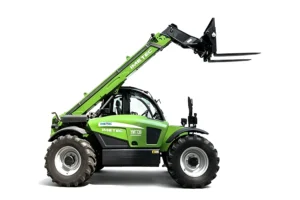
The operating cycle normally begins with loading. Forage and other ingredients are transferred from storage into the mixing chamber using a front loader, telehandler, conveyor, integrated loading mechanism, or another material-handling system. Where the machine includes weighing equipment, the operator can monitor the amount of each ingredient as it enters the chamber and compare the actual load with the planned ration.
Once the ingredients are inside, the mixing components begin moving them through a repeated circulation pattern. In a vertical machine, the auger usually lifts material upward before allowing it to fall back toward the lower part of the chamber. As this motion continues, ingredients pass repeatedly through different areas of the mixer, helping them become more evenly distributed throughout the batch.
Horizontal machines create a different flow pattern. Depending on the design, horizontal augers, paddles, or reels move material along and across the chamber. The principle remains the same: ingredients that entered separately need to become sufficiently distributed before the ration is discharged.
After the mixing process is complete, the ration exits through a discharge door, chute, conveyor, or another distribution mechanism. Mobile mixers can then place the feed directly along a feeding lane, while stationary systems normally transfer the prepared ration to another machine for distribution.
Why Mixing Quality Matters
A TMR mixer needs to do more than make the feed look visually combined. Ingredients entering the chamber may differ significantly in density, moisture, fiber length, and particle size. Moist silage is generally denser than dry hay, while mineral ingredients and concentrates occupy far less volume than bulky forage. The mixing process must therefore distribute very different materials throughout the ration without allowing one section of the batch to contain a noticeably different composition from another.
Consistency becomes especially important when one batch is distributed along a long feeding lane. If the physical composition changes significantly between the beginning and end of discharge, animals at different positions may not receive the same mixture. This problem cannot always be corrected simply by extending mixing time because excessive processing may also change forage particle structure.
Effective mixing therefore depends on the interaction between machine design, loading sequence, ingredient characteristics, batch volume, component condition, and operator procedure. Farms should evaluate both the machine and the finished ration rather than assuming that longer operation automatically produces better results.
Main Components of a TMR Feed Mixer
The mixing chamber is the central structure that contains the ration during preparation. Its shape influences how material moves around the augers and how much internal space remains available for circulation. Nominal volume is useful for comparing equipment, but practical working volume is more important because the ration needs enough room to move through the chamber.
The augers or other mixing elements provide the mechanical action that moves feed. Vertical machines may use one or several large augers, while horizontal equipment can use reels, paddles, or horizontally arranged augers. The number, size, and geometry of these components normally change according to machine capacity and intended application.
Cutting knives are particularly important where the ration contains long hay, straw, or other fibrous materials. Their sharpness and position influence how effectively forage is processed during mixing. A machine with worn knives may continue to operate, but processing time and ration structure can gradually change as cutting performance decreases.
Many mixers also include electronic weighing systems. Load cells measure changes in chamber weight as ingredients are added, helping the operator follow the planned ration more accurately. Depending on the equipment configuration, the machine may also include PTO drives, gearboxes, hydraulic systems, electrical controls, conveyors, discharge doors, and mobile drive components.
What Are the Main Types of TMR Feed Mixers?
TMR mixers can be classified by both mobility and mixing structure. These classifications often overlap, so a stationary mixer can use a vertical mixing system, while a self-propelled unit can also contain vertical augers.
| TMR Mixer Type | Main Characteristics | Typical Feeding Situation |
|---|---|---|
| Stationary mixer | Installed in a fixed preparation area | Centralized feed preparation with separate distribution |
| Towed mixer | Pulled and normally powered by a tractor | Farms already using tractors in daily feeding |
| Self-propelled mixer | Uses its own propulsion system | Integrated loading, mixing, transport, and distribution |
| Vertical mixer | Uses one or more vertical augers | Forage-rich livestock rations |
| Horizontal mixer | Uses horizontal mixing components | Fixed or specialized feeding systems |
A stationary mixer can work well where ingredients are concentrated around a central preparation facility. Because the machine remains in one location, the farm needs another method to move the finished ration to the feeding area, but the fixed arrangement can integrate effectively with conveyors, storage systems, or automatic feeding equipment.
Towed mixers combine preparation and transport while relying on a tractor for power and movement. They are practical where tractors are already part of daily feeding operations, although the farm must consider whether the required tractor is consistently available when feeding begins.
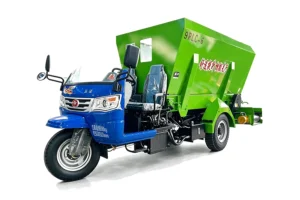
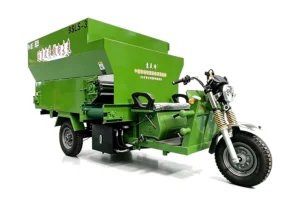
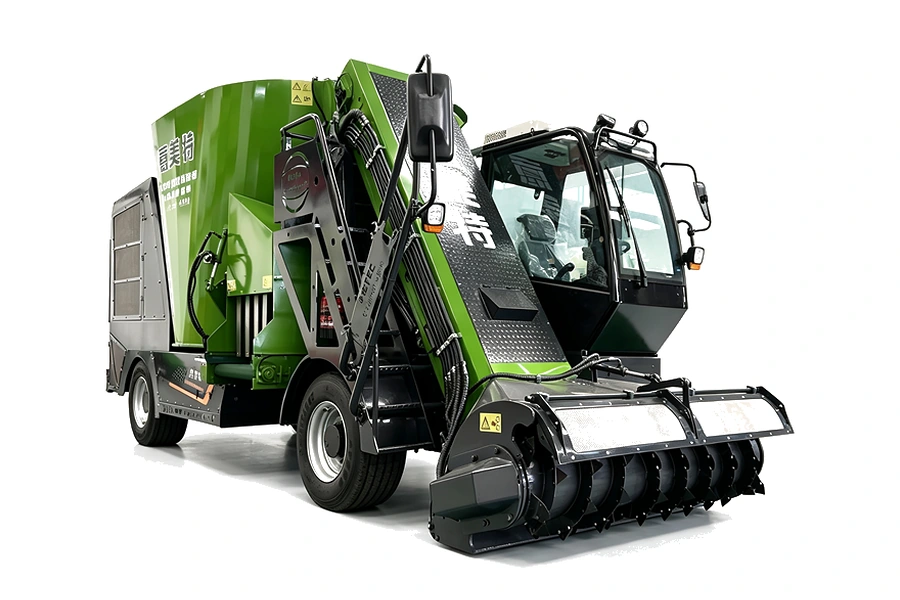
Self-propelled mixers can combine several operations within one machine. Depending on the configuration, the equipment may load, weigh, mix, transport, and discharge the ration. This can simplify workflow on farms where several barns or feeding areas must be served every day.
Vertical vs Horizontal TMR Feed Mixers

The main difference between vertical and horizontal mixers is the way material circulates inside the chamber. A vertical mixer normally uses one or more upright augers that lift feed upward and allow it to fall back through the mixing zone. This repeated movement is well suited to many forage-rich livestock rations because long and bulky materials can remain in contact with the augers and knives during processing.
Horizontal mixers use mixing components arranged along the chamber. Depending on the machine, these components can include horizontal augers, reels, or paddles that move feed lengthwise and laterally. This design creates a different type of mixing action and may suit operations with different ration characteristics or facility layouts.
Neither configuration is automatically better. A farm using large quantities of long, dry forage has different requirements from one using finely chopped silage and dense concentrates. The correct choice should therefore be based on the actual ration, the required batch volume, and the feeding system rather than on a simple preference for vertical or horizontal equipment.
What Feed Materials Can a TMR Mixer Handle?
A typical livestock ration may contain several materials with very different physical properties. Corn silage and grass silage usually contribute substantial moisture and density, while hay and straw are lighter, bulkier, and more fibrous. Concentrates and grains are smaller and denser, while minerals and supplements may represent only a small fraction of the total batch.
These materials do not behave identically inside the mixing chamber. Long forage may require more cutting and circulation, while fine ingredients must become distributed through a much larger volume of bulky feed without settling in isolated areas. Moisture content also affects how material moves, so a wet silage-based ration can behave very differently from one containing a high proportion of dry forage.
For this reason, a farm should provide equipment suppliers with information about the real ingredients it expects to process. Chamber volume alone does not show whether the machine is suitable for the ration. Ingredient density, moisture, fiber length, particle structure, and total batch weight all contribute to equipment selection.
Why Loading Sequence Is Important
The order in which ingredients enter the mixer can affect both processing and distribution. Long forage may need more contact time with knives and augers, while smaller ingredients may require less mechanical treatment. If all materials are loaded without considering their physical characteristics, some can be overprocessed while others remain unevenly distributed.
The most suitable sequence depends on mixer design and ration composition. Vertical and horizontal systems can require different loading practices, and changes in forage structure can also affect the ideal procedure. The important principle is consistency. Once the farm establishes a loading sequence that works well with its ration and equipment, operators should follow it in a repeatable way rather than changing the order from one batch to another.
Loading accuracy is equally important. A mechanically efficient mixer cannot correct large errors in ingredient quantity. If the amount of silage, concentrate, or supplement changes unintentionally, the final ration changes as well. For this reason, weighing systems and operator procedures should be considered part of the complete TMR process.
How TMR Feed Mixer Capacity Should Be Selected
Capacity is one of the first specifications most buyers compare, but it is also one of the easiest to misunderstand. A larger chamber does not automatically create a more efficient feeding system. The mixer must operate within a practical working range so that feed has enough room to circulate while still maintaining effective contact with the mixing components.
A useful capacity calculation should consider animal numbers, daily ration volume, ration density, the number of feeding groups, feeding frequency, and the desired number of batches. Two farms with the same number of cattle can require different mixers if one prepares a single ration while the other divides the herd into several groups with different nutritional requirements.
Ration density makes volume-only comparisons unreliable. A chamber filled with dry hay does not contain the same feed weight as the same chamber filled with moist silage and concentrates. Actual batch weight should therefore be estimated from the materials the farm plans to use rather than from cubic capacity alone.
Oversizing can reduce efficiency if the machine is regularly operated far below its intended working range, while undersizing can force operators to prepare too many batches each day. The correct capacity is the one that supports practical batch sizes without compromising mixing performance or extending the feeding cycle unnecessarily.
How Herd Size and Feeding Groups Affect Selection
Total herd size is useful, but it should not be the only factor used to select a mixer. Dairy farms often separate animals according to production stage or nutritional needs, which means several different rations may be prepared each day. A farm with a large herd can therefore require multiple moderate batches rather than one extremely large batch.
Beef cattle operations can have another feeding structure, with different groups for growing, finishing, or breeding animals. Sheep operations may involve smaller feed volumes and narrower feeding areas, making compact dimensions and discharge control more important than maximum chamber size.
The correct mixer should reflect the real organization of the livestock operation. Capacity selected from total animal numbers alone can look suitable on paper while creating inefficient batch sizes or impractical daily operating cycles.
TMR Feed Mixers for Dairy Farms
Dairy farms commonly use TMR systems because ration consistency and group management are central parts of daily feeding. Different groups may receive formulations suited to lactation stage or production requirements, so the feeding team needs equipment capable of preparing repeated batches according to planned ingredient quantities.
On these farms, weighing accuracy, mixing consistency, discharge control, and machine availability are particularly important. A mixer that experiences frequent downtime can interrupt the entire feeding schedule because ration preparation is a daily operation rather than an occasional task.
Facility layout should also influence equipment selection. The machine must fit through barn entrances, operate within available turning areas, and distribute feed efficiently along the intended feeding lanes. A mixer can have suitable technical specifications while still being impractical if its physical dimensions do not match the facility.
TMR Feed Mixers for Beef Cattle and Sheep Farms
Beef cattle farms can also benefit from mechanized TMR preparation where substantial quantities of forage and concentrates are used every day. In larger operations, batch capacity and transport efficiency may become especially important because the machine needs to prepare and distribute feed across several pens or feeding areas.
Smaller cattle and sheep farms may place greater emphasis on compact dimensions, maneuverability, and practical batch sizes. Selecting an excessively large mixer can increase power demand and reduce operating efficiency if the chamber is rarely filled to an effective working level.
This is why equipment should be matched to real material flow rather than selected on maximum capacity alone. The purpose of mechanization is to improve the feeding process, not to introduce unused capacity that increases equipment size without providing practical value.
How Mixing Time Affects the Final Ration
Mixing time depends on machine design, ingredient structure, batch volume, forage condition, loading sequence, and the condition of the mixing components. There is no single operating time that is appropriate for every mixer and every ration.
Insufficient mixing can leave ingredients unevenly distributed, but excessive mixing does not necessarily improve uniformity. Once the materials have been sufficiently combined, continuing to process the ration can further reduce forage particle size and increase equipment operating time without creating a better result.
A more reliable approach is to establish a repeatable procedure for the specific machine and ration. Farms can periodically compare feed discharged at different stages of the batch and observe whether visible differences develop. If consistency changes over time, the farm should inspect loading practice, batch size, knives, augers, and other components rather than automatically increasing mixing time.
Maintenance and Its Effect on Mixing Performance
TMR mixers operate in an abrasive environment, so several components experience gradual wear. Auger flighting can lose thickness and shape, while knives become dull through repeated contact with forage and other feed materials. The machine may continue to operate normally from the operator’s perspective, but material circulation and cutting performance can slowly deteriorate.
Drive and support components also require routine attention. Gearboxes, PTO shafts, bearings, hydraulic systems, belts, chains, conveyors, and discharge mechanisms should be inspected according to operating hours and manufacturer recommendations. On machines with weighing systems, load cells, wiring, and electronic displays also need to remain in good condition because inaccurate readings can affect ingredient loading.
Preventive maintenance is therefore closely connected to feed preparation quality. A mixer should not be judged only by whether the augers still rotate. Gradual changes in mixing time, power demand, forage processing, discharge behavior, or batch consistency can all indicate that maintenance is required.
Common TMR Feed Mixer Operating Mistakes
Overloading is one of the most common problems because operators may try to reduce the number of daily batches by filling the chamber beyond its practical working range. When there is insufficient space for material to circulate, adding more feed can reduce mixing effectiveness rather than improve productivity.
Inconsistent loading practices can create another source of variation. If operators use different ingredient sequences or do not follow planned weights carefully, batch composition can change even when the mixer itself is functioning correctly. Establishing a clear operating procedure helps reduce this variability and makes troubleshooting easier.
Another common mistake is responding to every mixing problem by extending operating time. If worn knives, incorrect batch volume, poor loading sequence, or auger wear is the real cause, additional mixing may increase energy use without solving the underlying issue. Effective troubleshooting should consider both machine condition and operating practice.
How a TMR Mixer Fits Into the Complete Feeding System
The mixer sits in the middle of a much larger material-handling process. Before mixing begins, ingredients must be stored, retrieved, transported, and loaded. After the ration is prepared, it must be moved to the feeding area, discharged consistently, and kept accessible to the animals.
This means the most efficient setup depends on how all the equipment works together. A stationary mixer can suit a centralized feeding facility, a towed machine may fit farms with appropriate tractors, and a self-propelled unit can reduce equipment changes where several tasks need to be combined.
Feed pushing is another downstream activity. Once livestock begin eating, ration can gradually move away from the accessible edge of the feeding area. Feed pushers perform a different role from mixers, but both belong to the same overall feeding workflow. Looking at the entire process from storage to animal access makes it easier to identify where each machine creates real operational value.
What Should Buyers Consider Before Choosing a TMR Feed Mixer?
The best starting point is to document the farm’s current feeding process. Buyers should understand how much feed is prepared each day, how many different rations are required, what ingredients are used, how those ingredients are stored, and how they are currently moved into the feeding area. These details provide a much stronger basis for equipment selection than choosing a mixer according to chamber size alone.
Available machinery also needs to be considered. A towed mixer depends on a suitable tractor, while many systems require a loader or telehandler for ingredient handling. If those machines are already heavily used for other tasks, adding a new mixer can create scheduling conflicts that reduce the expected improvement in feeding efficiency.
Physical conditions are equally important. Feed-lane width, barn entrances, ceiling height, turning radius, road conditions, slopes, loading space, and discharge direction can all affect whether a particular machine works efficiently on the farm.
Future expansion should also be considered, but this does not mean buying the largest machine available. The better approach is to choose a mixer that works efficiently under current conditions while providing enough flexibility for realistic increases in herd size or feed volume.
How to Judge Whether a TMR Mixer Matches Your Farm
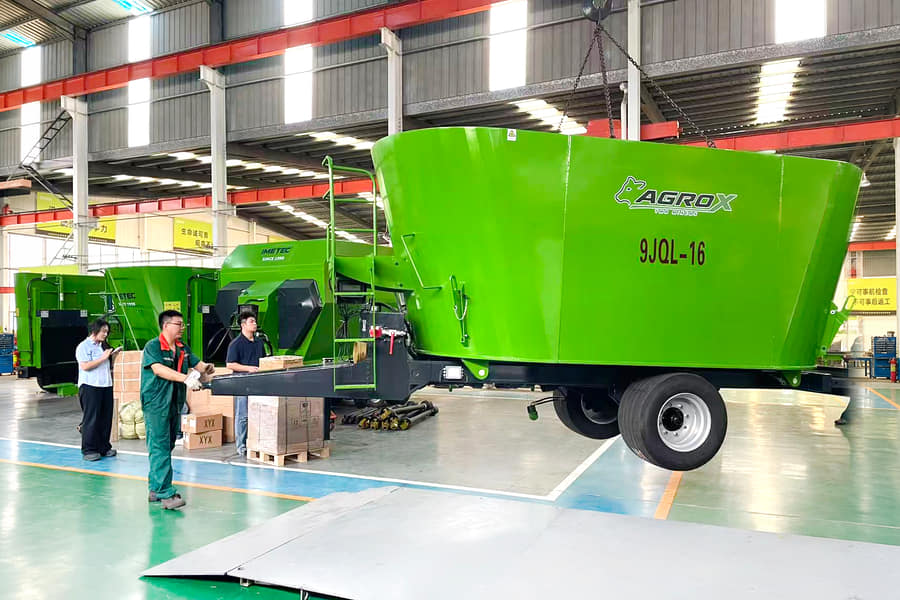
A suitable mixer should make the daily feeding process easier to control. It should handle the intended ration without excessive processing, prepare practical batch sizes, integrate with existing loading equipment, move safely through the farm, and discharge feed where it is needed.
Daily operating time is another important measure. Loading time, mixing time, travel distance, discharge time, and the number of batches all influence the total feeding cycle. Two machines with similar nominal capacity can create very different workflows if one requires more equipment changes or longer travel between operations.
Maintenance access and spare-parts planning also matter. A machine used every day will eventually require knife replacement, auger inspection, bearing service, hydraulic maintenance, or weighing-system adjustment. Equipment that fits the ration but is difficult to maintain can create operational problems over the longer term.
For this reason, the most useful selection process combines technical specifications with a clear understanding of the farm’s complete daily feeding workflow.
Conclusión
A TMR feed mixer is a livestock feeding machine designed to combine forage, silage, concentrates, minerals, supplements, and other ration ingredients into a controlled mixture before distribution. Its value comes not only from mixing, but from connecting ingredient handling, weighing, forage processing, transport, and feeding into a more organized daily process.
The correct machine depends on far more than nominal chamber capacity. Mixer design, ration density, forage structure, herd size, feeding groups, batch requirements, available tractors and loaders, barn dimensions, discharge arrangement, maintenance access, and future expansion all need to be considered together.
For farms evaluating TMR equipment, the most practical approach is to begin with the current feeding workflow and identify where material handling, labor, feeding time, or batch consistency creates limitations. Once daily feed volume, ingredients, batch size, loading method, and distribution requirements are clear, it becomes much easier to determine which mixer configuration is appropriate.
Preguntas frecuentes
What does TMR stand for in a TMR feed mixer?
TMR stands for Total Mixed Ration. It describes a feeding method in which forage, concentrates, minerals, vitamins, and other ration components are combined into one prepared mixture. The mixer provides the mechanical process for combining these materials, while the ration formula itself is based on the nutritional requirements of the livestock.
Is a TMR feed mixer only suitable for dairy farms?
No. Dairy farms are common users of TMR systems, but the equipment can also be used in beef cattle and other livestock operations where mixed forage-based rations are prepared. The appropriate configuration depends on feed volume, ingredient structure, herd organization, facility layout, and the number of feeding groups.
How do I choose the right TMR feed mixer capacity?
Capacity should be based on actual batch requirements rather than herd size alone. Farms need to consider daily ration volume, ration density, feeding groups, desired batches per day, usable chamber volume, and ingredient characteristics. The objective is to avoid both chronic overloading and inefficient operation with batches that are too small for the machine.
What is the difference between a vertical and horizontal TMR mixer?
A vertical mixer normally uses upright augers to lift and circulate the ration, while a horizontal mixer moves material with components arranged along the chamber. Both can work effectively when matched to the correct application. Forage length, ration composition, capacity, installation conditions, and desired material movement should guide the selection.
How can I tell if a TMR feed mixer is not mixing correctly?
Possible signs include visible differences between material discharged at different stages of the batch, increasing mixing time, poorly processed forage, inconsistent discharge, or unusual changes in power demand. These problems can result from loading practices, incorrect batch volume, worn knives, auger wear, or other mechanical conditions.
Need Help Choosing the Right TMR Feed Mixer?
A suitable TMR mixer should be matched to herd size, ration ingredients, daily batch volume, available loading equipment, farm layout, feeding groups, and discharge requirements. Share these operating conditions with the Equipo de equipamiento ganadero LTSZ to discuss a configuration that fits your feeding workflow.